Australia's Growth Headline Is Hiding a Productivity Problem
The economy grew 0.4 per cent in the June quarter, but GDP per person was flat and productivity remains weak. Australia cannot build lasting prosperity on a headline number alone.

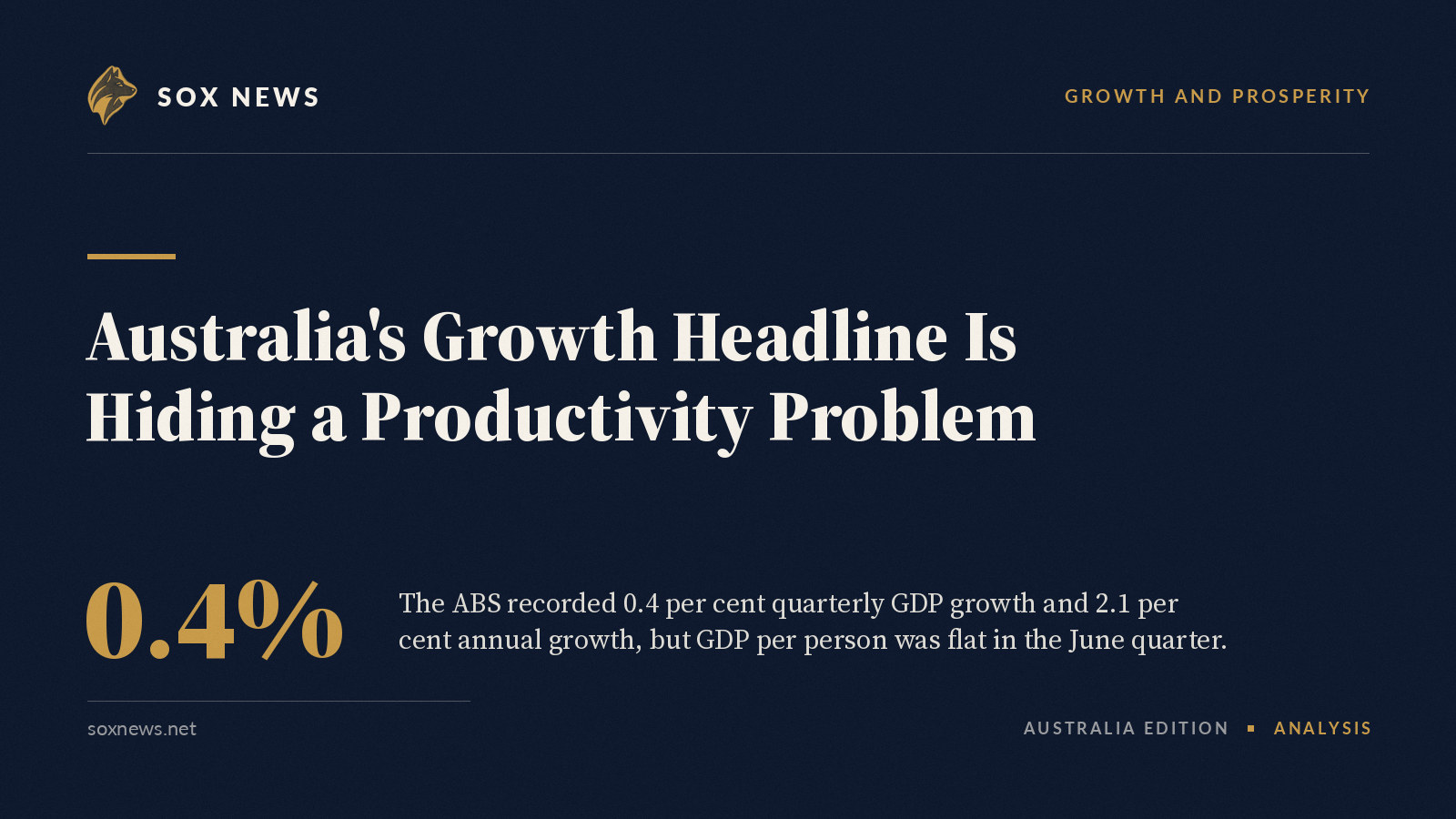
Australia's economy grew 0.4 per cent in the June quarter and 2.1 per cent over the year, according to the Australian Bureau of Statistics. That is a respectable headline. It is less reassuring when GDP per person was flat over the quarter and the economy's gains were concentrated in a narrow set of activities.
Household consumption rose 0.4 per cent and contributed 0.2 percentage points to quarterly growth. The ABS says record sales of electric and hybrid vehicles helped drive discretionary spending, while essential spending fell 0.3 per cent. The household saving ratio edged up to 6.5 per cent from 6.4 per cent, a sign that households are still managing risk rather than spending with confidence.
Australia's answer should be to make productive investment easier, not to celebrate a quarterly number and hope.
From the analysisThe investment picture is mixed. Total private gross fixed capital formation was 8.4 per cent higher than a year earlier, helped by construction and a pipeline of data centre, renewable and mining projects. But private business investment fell 0.5 per cent in the quarter, and the ABS recorded no quarterly contribution from private investment to GDP growth. Westpac estimates that growth ran at an annualised 1.5 per cent in the first half of 2026, down from 2.8 per cent in the second half of 2025.
External costs are making the composition of growth harder to ignore. The terms of trade fell 1.6 per cent in the quarter as fuel, fertiliser, plastics and freight became more expensive. Exports rose 0.8 per cent, led by coal, while imports rose 0.5 per cent. That helped net trade add 0.1 percentage points to GDP, but it does not remove the pressure that higher imported costs place on households and firms.
ABC News reported that labour productivity was unchanged in the quarter, 0.2 per cent lower than a year earlier and 5 per cent below its peak, citing Asia-Pacific economist Callam Pickering. The same report said market pricing lifted the estimated chance of a September Reserve Bank rate rise to about 70 per cent after the GDP release. A stronger-than-expected aggregate number can therefore coexist with weaker output per person, poor productivity and a central bank still worried about inflation.
That is the policy trap. If demand is resilient enough to keep inflation above target, the RBA may keep rates high or raise them again. But rate rises do not build houses, expand the grid or make businesses more productive. They can suppress spending while leaving the supply problem intact, which is how a country ends up with decent national growth and a thinner sense of progress in ordinary households.
Australia's answer should be to make productive investment easier, not to celebrate a quarterly number and hope. Planning should release land and infrastructure faster. Energy should be reliable and affordable. Tax settings should stay stable long enough for housing, data centres and industrial projects to be financed. The growth headline is real, but prosperity will be measured by what Australia can produce per person when the temporary supports and favourable commodity flows fade.
The Semaform
The ABS reported 0.4 per cent quarterly GDP growth and 2.1 per cent annual growth in the June quarter, alongside flat GDP per person and mixed investment data.
Australia should focus on productivity, reliable energy, faster infrastructure and stable rules for investment rather than treating aggregate GDP growth as proof that living standards are improving.
The economy is growing faster than expected and household demand remains resilient, so the RBA may reasonably keep policy restrictive until inflation is clearly returning to target. Structural reforms take time and cannot substitute for monetary discipline.
Sources
A human editor is accountable for this analysis. Read our editorial standards, how we use AI, what the content labels mean, and how to ask for a correction.