Canada's Tariff Retaliation Puts Consumers in the Crossfire
Canada will match new US tariffs on $27.6 billion of goods while spending $7.5 billion to cushion the shock. The bill will still reach Canadian buyers.

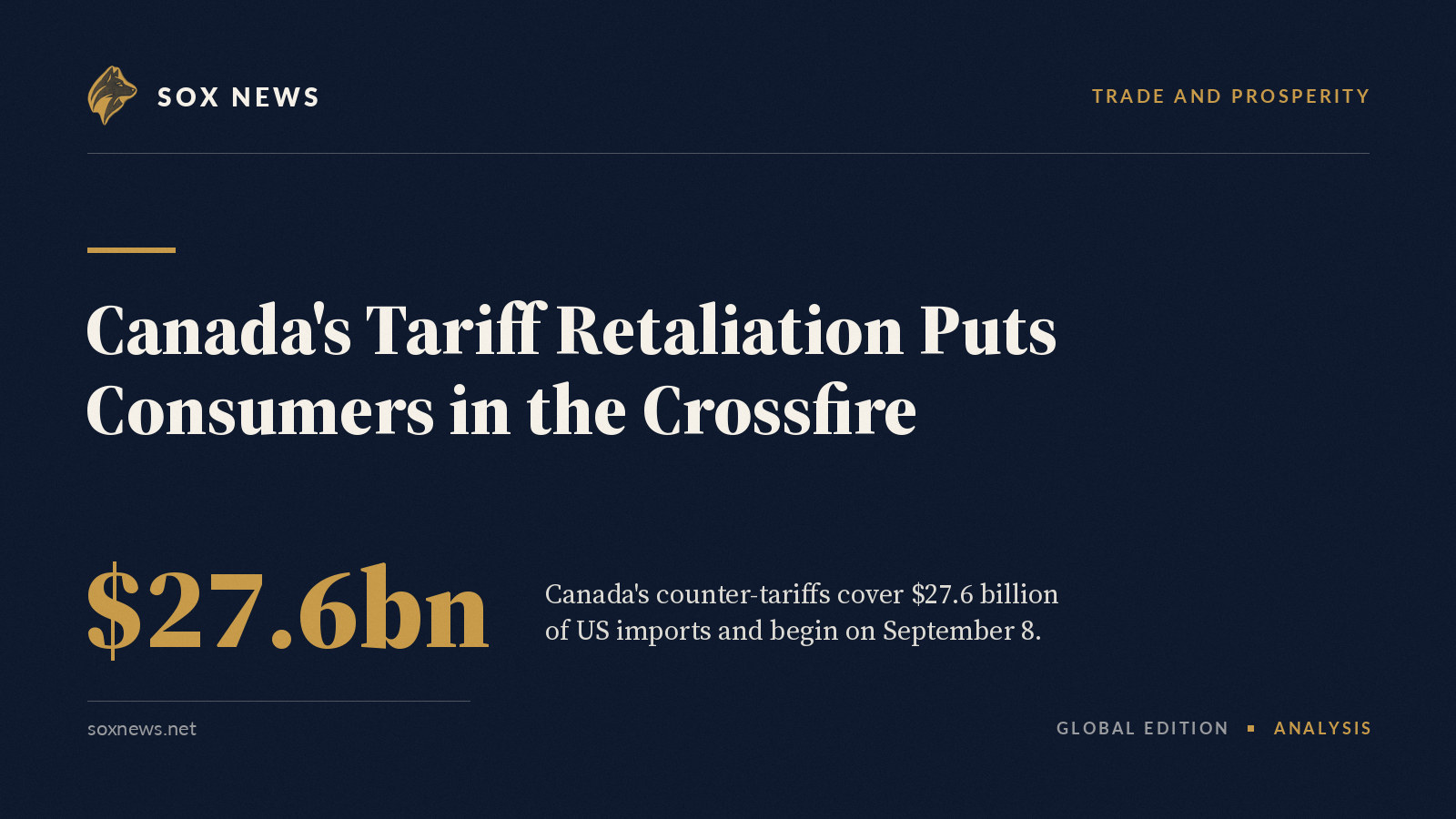
Canada has chosen a hard answer to Washington's latest tariff escalation. The United States imposed a 50 per cent tariff on $27.6 billion of Canadian goods from August 22. Ottawa will answer on September 8 with 15, 25 and 50 per cent counter-tariffs covering the same value of US imports.
The matching logic is easy to understand. Steel, dairy, appliances, farm equipment, pulp and paper, electronics, furniture and clothing are all exposed to the new measures. Canada is trying to show that access to its market has a price when a neighbour taxes Canadian production.
The counter-tariffs may be defensible as a negotiating instrument.
From the analysisThe economic cost is less tidy. A tariff collected at the border is paid first by an importer, then worked through a supply chain and eventually reflected in a price, a margin or a job. Canadian households may never see the customs line, but they can still pay for it in a more expensive appliance, a narrower choice of supplier or a business that delays investment.
Ottawa is also offering a $7.5 billion support package. It includes $1.5 billion for regional development, a $500 million liquidity stream through the Business Development Bank of Canada, $2 billion for tariff affected projects and $3.5 billion in worker and employer supports. The package is substantial, and it may protect viable firms from a sudden cash flow squeeze.
Support cannot turn a tariff into free trade. It can buy time for a manufacturer or a worker, yet it also shifts the shock onto taxpayers and future budgets. A programme that begins as emergency liquidity can become a permanent subsidy if policymakers confuse survival during a trade dispute with competitiveness in normal conditions.
The product list updated on August 26 offers one sensible limit. Goods already in transit on September 8 are excluded, which avoids changing the rules halfway through a shipment. The remission framework also leaves room for exceptional relief. Those escape valves should remain narrow, transparent and temporary.
Canada's best long term response is supply, choice and speed. Use the dispute to remove internal trade barriers, approve capital faster, widen access to alternative suppliers and lower domestic costs wherever Ottawa controls them. A country that makes it easier to build and trade has more leverage than one that simply adds another tariff schedule.
The counter-tariffs may be defensible as a negotiating instrument. They are a poor economic destination. Ottawa should make clear that relief expires, support is tied to productivity and Canadian consumers will not be asked to finance a permanent trade war through higher prices and slower growth.
The Semaform
Canada will impose matching counter-tariffs on $27.6 billion of US goods from September 8, alongside $7.5 billion of worker and business support.
Canada should use temporary retaliation as leverage while lowering domestic barriers, protecting consumers and tying support to productivity rather than permanent subsidy.
Matching tariffs may be necessary to create negotiating leverage and defend exposed industries. The risk is that a measure intended to punish foreign policy becomes a durable tax on Canadian households and firms.
Sources
- Department of Finance Canada, Canada announces targeted countermeasures and substantive support for workers and businesses in response to U.S. tariffs, 25 August 2026
- Department of Finance Canada, List of products from the United States subject to counter-tariffs effective September 8, 2026, updated 26 August 2026
- Reuters, Canada announces $20 bln retaliatory tariffs on US goods, unveils support measures, 25 August 2026
A human editor is accountable for this analysis. Read our editorial standards, how we use AI, what the content labels mean, and how to ask for a correction.